
Cyber Security & Compliance Articles

Explore real-world case studies, regulatory supply chain mandates, and empirical data demonstrating how NCSC Cyber Essentials reduces cyber incident exposure across UK organisations.

🚨 BREAKING AI THREAT ADVISORY // CVSS 9.2 CRITICAL (22 OCT 2026) NCSC CONTROL #5: 14-DAY PATCH DEADLINE (04 NOV 2026)

AI-Discovered “PHP2Shell” RCE Vulnerabilities (CVE-2026-109618 & CVE-2026-109619): Technical Analysis, Mitigation Guide & NCSC Cyber Essentials Compliance

A landmark coordinated disclosure on 21 October 2026 has revealed two critical, unauthenticated Remote Code Execution (RCE) vulnerabilities in the core C runtime of the PHP programming language—collectively tracked as “PHP2Shell” (CVE-2026-109618 & CVE-2026-109619, CVSS 4.0 score 9.2). Uncovered by security researchers using frontier AI code-reasoning models to trace deep memory-exhaustion and interruption edge cases across decades-old C interpreter code, these flaws affect PHP versions 5.4 through 8.5 across PHP-FPM, Apache mod_php, php-cgi, FrankenPHP, and LiteSpeed. Because exploitation occurs inside the PHP engine before application code runs, standard WordPress, Laravel, Drupal, Magento, or Moodle security plugins cannot block the attack.
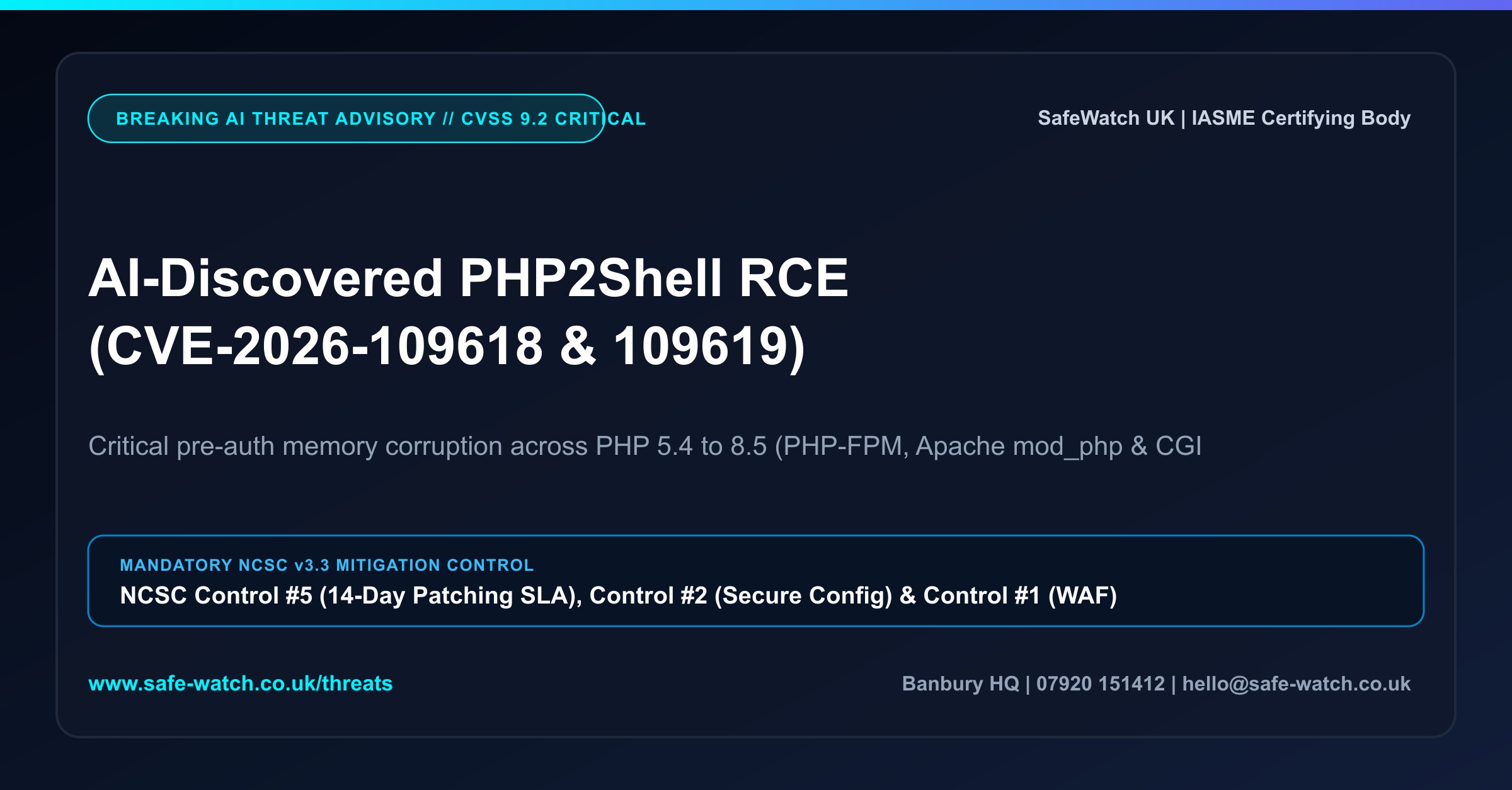
AI-Discovered PHP2Shell RCE CVE-2026-109618 and CVE-2026-109619 Advisory Banner
Figure 1: SafeWatch UK Threat Intelligence Advisory — AI-discovered PHP2Shell RCE (CVSS 9.2) impacting PHP 5.4–8.5.
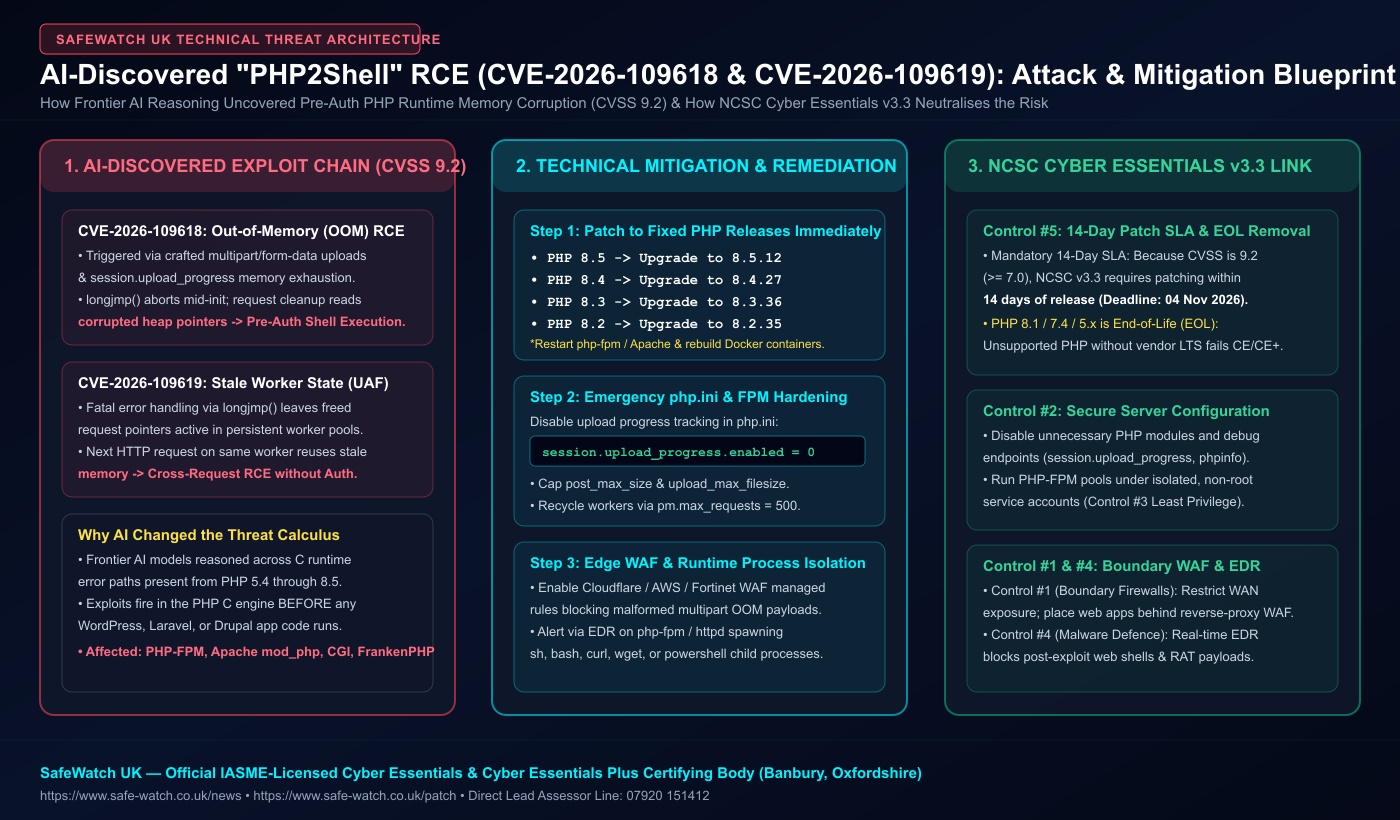
PHP2Shell CVE-2026-109618 and CVE-2026-109619 Attack Chain, php.ini Mitigation Guide, and NCSC Cyber Essentials Mapping
Figure 2: 3-Stage Technical Blueprint — OOM/UAF exploit mechanics, php.ini hardening, and NCSC Cyber Essentials v3.3 controls.

1. How AI Uncovered the Core PHP Flaws

  • CVE-2026-109618 (OOM Cleanup RCE — CVSS 9.2): When PHP hits an Out-of-Memory (OOM) limit mid-request (such as crafted multipart/form-data uploads interacting with session.upload_progress), PHP aborts via longjmp(). Partially initialised heap structures are then evaluated during request cleanup, enabling unauthenticated shell execution.
  • CVE-2026-109619 (Stale Worker State / UAF — CVSS 9.2): Fatal error interruption leaves freed pointers active inside persistent worker pools (PHP-FPM, Apache mod_php, FrankenPHP). The next HTTP request handled by that worker reuses corrupted pointers for RCE.
  • The AI Shift: Frontier AI models traced multi-step memory state transitions across C destructors that eluded manual audits for over a decade—warning defenders that AI now compresses the window between code audit and weaponised exploit.

2. Step-by-Step PHP2Shell Mitigation Guide

  • Step 1 — Upgrade PHP Immediately: Deploy the emergency upstream releases published on php.net:
    • PHP 8.5 → 8.5.12  |  PHP 8.4 → 8.4.27
    • PHP 8.3 → 8.3.36  |  PHP 8.2 → 8.2.35
    Crucial: Restart all php-fpm / Apache daemons and rebuild Docker images so persistent workers load the patched binary.
  • Step 2 — Emergency php.ini Workaround: If immediate patching is delayed, disable session upload progress tracking globally in php.ini: session.upload_progress.enabled = 0
  • Step 3 — Worker Recycling & WAF Rules: Lower pm.max_requests = 500 in PHP-FPM pools and enable Cloudflare / AWS WAF virtual patching rules.

3. How NCSC Cyber Essentials Mitigates This

🛡️ SAFEWATCH LEAD ASSESSOR DESK // 24–48 HOUR FAST-TRACK SLA

Need to Prove 14-Day Patch & NCSC Denzell Compliance for a Tender, School MAT, or Insurer?

Get an instant fixed-fee quote from £320 + VAT (includes Pre-Assessment Review, 14-Day Free Remediation Cover, and £25,000 complimentary cyber insurance for eligible UK SMEs).

🧭 INTERACTIVE PLAIN-ENGLISH GUIDE FOR NON-TECHNICAL USERS

Not an IT Specialist? Find Out Exactly What Action You Need to Take in 60 Seconds

You do not need to understand server code to protect your organisation. Answer 4 simple questions below to generate a plain-English action plan, a ready-to-send email for your web designer or IT support company, and links to official NCSC resources.

Question 1 of 4
1. How was your organisation’s website or client portal built?

Over 75% of UK business websites use WordPress or PHP under the hood—even if you never see it.
Select any option above to continue automatically
🏫 UK Schools & Multi-Academy Trusts (Bromcom PHP & School MIS Advisory): Running a school WordPress site, Moodle VLE, or PHP-connected MIS portal alongside Bromcom, Arbor, or SIMS? Ensure your trust meets the mandatory 14-day patching rule and DfE Risk Protection Arrangement (RPA) conditions with our Cyber Security Audit for Multi-Academy Trusts & Schools or run a free Cyber Essentials Gap Analysis.
MAT & School Audit Guide →
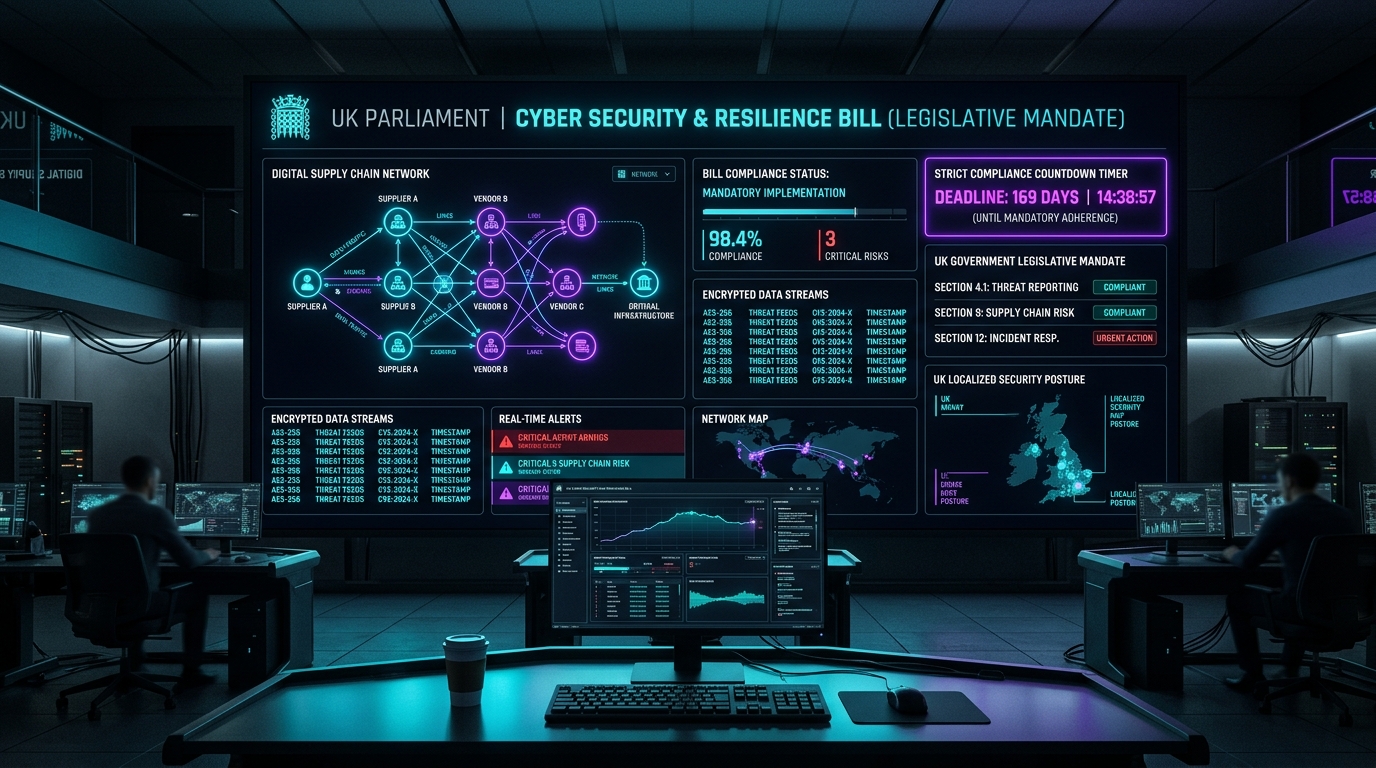
UK Cyber Security and Resilience Bill Parliamentary Mandate 🏛️ PARLIAMENTARY MANDATE // 2026

UK Cyber Security & Resilience Bill: Strict Incident Reporting & Supply Chain Mandates

The UK Government has introduced the landmark Cyber Security and Resilience Bill, expanding regulatory oversight beyond traditional Critical National Infrastructure (CNI) to digital supply chains, Managed Service Providers (MSPs), and IT contractors. The legislation enforces a mandatory 24-hour initial incident notification window and legally binding baseline security requirements. With recent surveys showing only 10% of UK organisations are confident in their compliance readiness, achieving NCSC Cyber Essentials has become the primary procurement requirement for suppliers to prove baseline resilience and protect against severe regulatory enforcement.

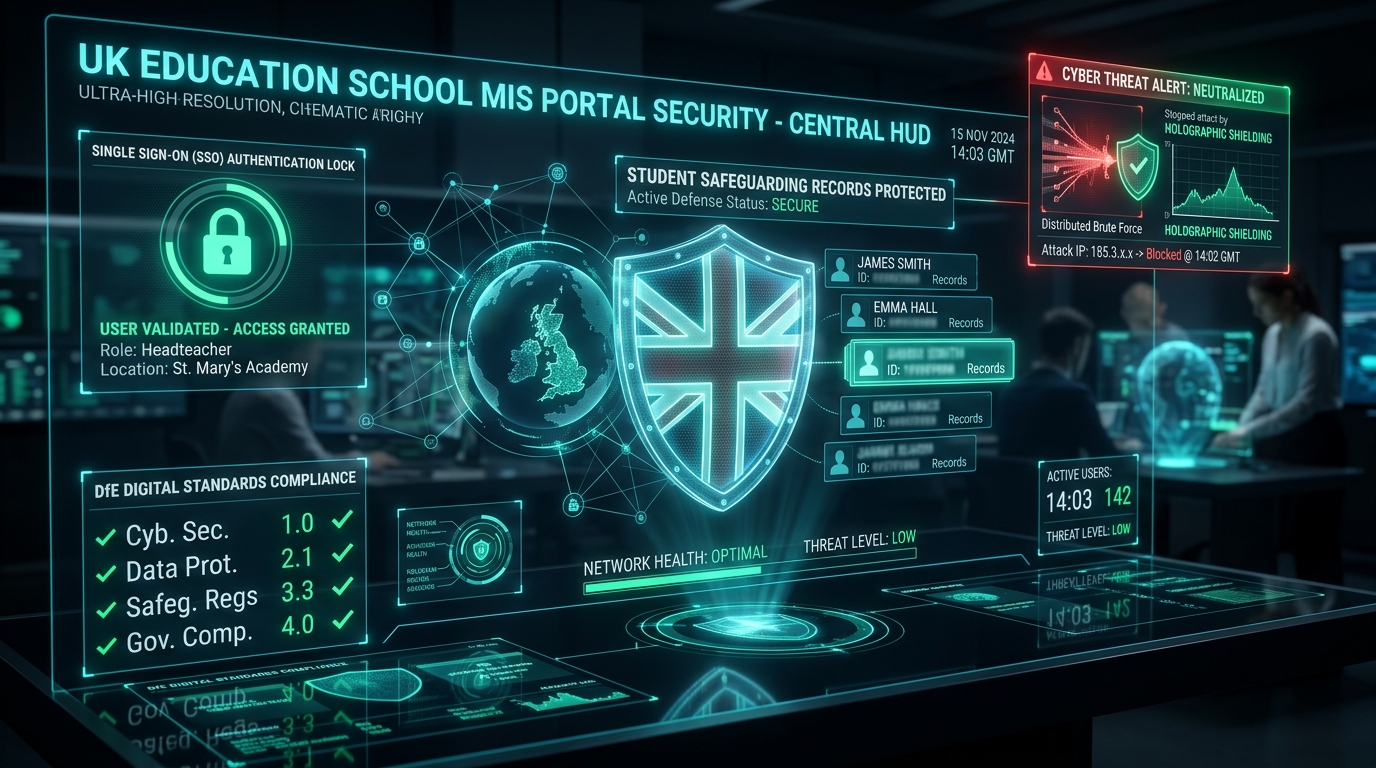
UK Education School MIS Portal Cyber Defence and DfE Digital Standards 🏫 EDUCATION & MATs // SAFEGUARDING

Bromcom MIS Vulnerability & DfE 607k Portal Incident: 4 Mandatory Safeguards for Schools

Following widespread sector concern over the Bromcom school Management Information System (MIS) credential exposure and the unauthorized data access incident compromising 607,000 educator records on the DfE teacher portal, UK schools and Multi-Academy Trusts face urgent audit pressure. Criminal syndicates actively target student safeguarding files (CPOMS/MyConcern) and payroll data. SafeWatch outlines 4 mandatory technical mitigations under DfE Meeting Digital and Technology Standards: phishing-resistant MFA on all cloud portals, strict role-based access control, automated third-party API revocation, and network VLAN isolation between pupil Wi-Fi and administrative systems.

🚨 PUBLIC SECTOR & LAW ENFORCEMENT

Dyfed-Powys Police IT Disruption & Scattered Spider: Stopping Helpdesk MFA Social Engineering

The non-emergency IT systems disruption at Dyfed-Powys Police and the sentencing of Scattered Spider (UNC3944) operatives responsible for the Transport for London (TfL) extortion attack underscore a critical operational threat: cybercriminals are increasingly bypassing technical firewalls via voice-phishing (vishing) targeting IT service desks. Attackers impersonate legitimate staff to dupe helpdesk agents into issuing temporary MFA reset codes. Under NCSC Control #2 (Secure Configuration) and Control #3 (User Access Control), organisations must implement out-of-band identity verification for credential resets and restrict administrative escalation paths.

🏥 HEALTHCARE & NHS SUPPLY CHAIN

NHS Synnovis Pathology Attack Post-Mortem: Why Healthcare Suppliers Need Cyber Essentials Plus

The Russian-linked Qilin cyber attack on Synnovis pathology services forced King's College Hospital and Guy's and St Thomas' NHS Foundation Trusts into declaring a critical incident, postponing over 10,000 appointments and blood transfusions. Forensic reports confirm attackers compromised an unpatched third-party VPN portal that lacked phishing-resistant MFA. This incident proves that healthcare supply chains are primary cybercrime targets. Learn why the NHS Data Security and Protection Toolkit (DSPT) and Cyber Essentials Plus certification are now non-negotiable for all NHS suppliers.

ASOS Cyber Breach Analysis and Cyber Essentials Supply Chain Controls 🛍️ RETAIL & E-COMMERCE // BREACH POST-MORTEM

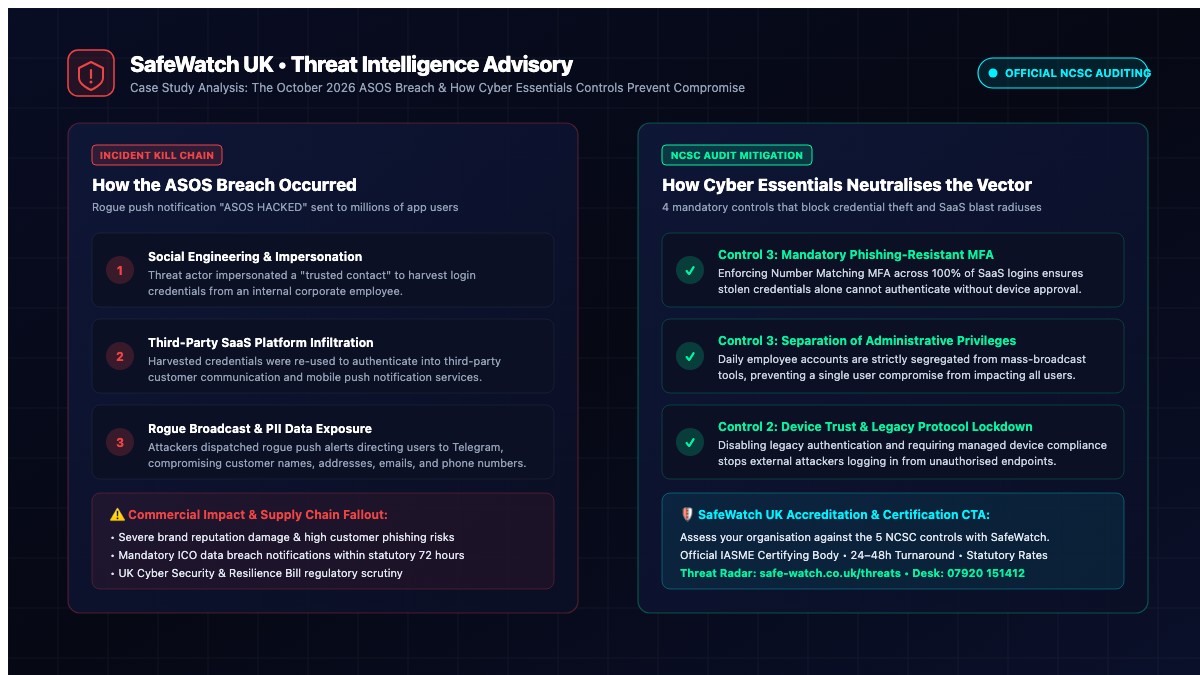
ASOS Supply Chain Breach Analysis: How Cyber Essentials Prevents Third-Party Account Takeovers

The high-profile cyber incident impacting UK e-commerce leader ASOS demonstrates how modern attackers bypass enterprise boundaries by infiltrating peripheral vendor portals, credential-stuffing unhardened marketing integrations, and abusing unsegmented third-party API keys. SafeWatch's technical post-mortem breaks down how mandatory Cyber Essentials Controls—specifically 100% MFA across external collaborator portals (Control #3), boundary firewall lockdown on partner integration endpoints (Control #1), and rapid 14-day CVE patching (Control #5)—neutralize retail supply chain pivot tactics before customer data is compromised.

🚨 BREAKING UK THREAT INTEL

Akira & Chaos Ransomware Target UK Engineering & Manufacturing Primes

Recent late-August attacks on UK consultancies highlight that 30% of UK manufacturers suffered breaches via unfortified supply chains. Learn how NCSC Control #3 (MFA), Control #4 (Malware Protection), and Control #5 (14-Day Patching) neutralize up to 80% of these commodity exploits.

⭐ FEATURED CASE STUDY

St. James’s Place Mandates Cyber Essentials Across 2,800+ Partner Practices

How UK wealth giant St. James’s Place (£170B AUM) achieved an 80% reduction in cyber security incidents by enforcing NCSC baseline controls across 2,800+ partner advisory firms.

📡 GLOBAL INCIDENT ANALYSIS

Anatomy of Telecom & Banking Cyber Outages in Angola

Technical breakdown of the Unitel IPO cyber attack and Central Bank breaches, highlighting how unpatched edge routers and missing MFA crippled nationwide SMS 2FA and banking.

🚨 NCSC JOINT ADVISORY

NCSC Warning: State-Sponsored Targeting of SME Perimeter Routers

Technical advisory detailing threat actor exploitation of unpatched office firewalls and VPN gateways, and how Cyber Essentials Control #1 and #5 block 80%+ of attack vectors.

NCSC RESEARCH

Cyber Essentials Proven to Reduce Cyber Incidents by Up to 80%

Government and NCSC telemetry confirms that enforcing boundary firewalls, MFA, secure configurations, malware defence, and 14-day patching blocks up to 80% of common commodity cyber attacks.

NON-PROFIT GUIDE

Securing Non-Profits & Community Hubs With Cyber Essentials

How non-profit organisations work alongside our team of industry experienced assessors to audit perimeters, enforce MFA on booking portals, and secure £25,000 in free cyber insurance cover.

GOVERNMENT MANDATE

PPN 09/14: Why Cyber Essentials is Required for Public Sector Tenders

A breakdown of Cabinet Office Procurement Policy Note PPN 09/14 and why defence, healthcare, and public sector contractors must hold valid Cyber Essentials verification.

DFE EDUCATION MANDATE

Cyber Security Audits & Pentesting for Academy Trusts & Schools

Learn how Multi-Academy Trusts (MATs) and UK schools satisfy Department for Education (DfE) Cyber Security Standards and ESFA funding mandates through accredited audits.

CONTINUOUS COMPLIANCE

Why 365-Day Continuous Compliance Beats Annual Point-in-Time Audits

Why forward-thinking UK CISOs are shifting from stressful annual audit rushes to continuous compliance retainers featuring 4 quarterly reviews and year-round assessor access.

REGIONAL SME SECURITY

Cyber Essentials for SMEs in Banbury, Bicester, Warwick & Oxford

How regional businesses across Cherwell, Warwickshire, and Oxfordshire protect commercial livelihoods and satisfy supply chain requirements with direct Industry Experienced Assessor guidance.

Ready to Secure Your Organisation or Supply Chain?

Whether you are an independent practice, a growing SME, or an enterprise managing hundreds of suppliers, SafeWatch makes Cyber Essentials simple and stress-free.

Request Custom Audit Scope → Speak With Industry Experienced Assessor Desk